


GEO and AEO Agency
We earn organic citations for European brands across ChatGPT, Perplexity, and AI Overviews, while managing the paid side of the channel. Because AI search in Europe behaves nothing like the US, we lead with published methodology, clear boundaries and a straight answer when GEO isn’t worth the spend.
What GEO & AEO Actually Are
Two Acronyms, Same Goal
GEO (Generative Engine Optimization) is the work of getting your content cited when a language model writes an answer. AEO (Answer Engine Optimization) is essentially the same job, just focused on making sure the model can easily extract your answers.
One Job, Three Metrics
The industry hasn’t settled on a distinction, and agencies define the split in contradictory ways. We ignore the debate and treat them as one job, measured three ways: how often you’re mentioned, how often you’re linked, and what that resulting traffic is actually worth.
The Shared Foundation
This isn’t traditional SEO, but they share the exact same foundation. A page that can’t be found or trusted won’t rank on Google, and it won’t be cited by an AI. The difference is simply the goal: a click in a list of links versus a citation in an answer. Technical SEO and content strategy are the groundwork here, not a separate invoice.
Customer Story

I was initially skeptical about AI solutions but BrightBid exceeded every expectation. In record time, we went from struggling to leading our local market across search and AI answer engines!
Saki Carapanos, CEO Södermäklarna
How BrightBid Does GEO & AEO Optimization
Four workstreams. The first three make you citable. The fourth decides whether you keep paying for it.
Make LLMs Believe
We map what each engine currently answers against the questions your buyers actually ask. The cheapest reason you go unmentioned is simply incorrect facts (an old name, a retired product, the wrong headquarters).
The Fix: We build a cross-referenced, machine-readable entity graph of your company facts, products, and credentials.
When an engine pulls from three different places, it gets one consistent answer instead of three conflicting ones.
Make LLMs Extract
A model cites a passage, not a page. We rebuild your existing pages first, it’s faster, and current rank position strongly predicts citation, so they are instantly readable by AI:
- Dual-serving: For dense pages, we serve a clean, machine-readable version alongside the human-facing design.
- Structure: Headings that ask the exact question, followed by a direct answer in the first sentence.
- Formatting: Sourced numbers placed in the running text, never trapped inside images.
- Clarity: Hedged or comparative phrasing gets cut down to direct, falsifiable statements.
Win Back Brand’s Credibility
AI answers are prone to cite third-party domains like trade media and Reddit, but you do not have to accept this as a permanent ceiling.
- The Angle: We upgrade your on-site execution with strict GEO structures (Q&A formatting, structured data, and first-party data) to force AI models to outweigh third-party noise and directly cite your domain instead.
- The Map: We track exactly which external sources are retrieved in your category and measure your competitors’ citation share.
Measure and Attribute
We do the part almost nobody does honestly: telling you exactly which numbers are measured, which are modeled, and which are not knowable.
- Reconciliation: Triangulating actual AI-referred traffic across GA4, Search Console, and server logs.
- Tracking: A frozen prompt panel, asking the same questions every month, with each engine reported separately.
Start with a measurement, not an proposal
We run your prompt panel once and show you what the four engines say about you today, who they cite instead, and what it would cost to change that. Then you decide.

Customer Stories
Real Results, Real Impact
See how businesses like yours transformed their ad performance with BrightBid.





Increased ROAS

BrightBid helped Blique by Nobis conversions from PPC by 45% and Return on AdSpend by 216% within 8 weeks of starting with us.
+45%
Increase website traffic
+257%
Revenue
+216%
Increased ROAS
GEO & AEO FAQ
A GEO agency works to get your brand mentioned and cited when a language model writes the answer to a question. In practice that is three things: correcting what the models already believe about you, rebuilding content so passages can be extracted from it, and working the third-party sources that are actually retrieved in your category. Plus measurement, which is the part that determines whether any of it is worth the money.
In practice, no settled difference. GEO stands for Generative Engine Optimization and AEO for Answer Engine Optimization, and both describe the work of being visible in AI-generated answers. The industry defines the split in mutually incompatible ways, and one of the largest platforms in the category answers the question with “nothing, they’re the same thing.” We use both terms because the market does, but we don’t sell two services out of it.
No, but it isn’t separate from it either. A page that can’t be found, read or trusted won’t rank in Google and won’t be cited by a model — the foundation is shared, and Google rank position remains one of the strongest observable predictors of whether a page gets cited. What differs is what you optimise toward: a position in a list of results, or a sentence in an answer that often produces no click. Technical SEO and content strategy are part of our groundwork, not a separate invoice.
ChatGPT, Perplexity, Microsoft Copilot and Google’s AI Overviews and AI Mode as standard, each reported separately. The separation matters more than the count: across 3.7 million citations, 91 % appeared in only one engine, and just 2.37 % of cited URLs appeared in ChatGPT, Perplexity and AI Overviews for the same prompt. A single blended “AI visibility score” averages away the only thing you can act on.
Corrections to facts about your own company can land within weeks, because engines retrieve pages in real time. Structural content work and third-party evidence move over months. The models’ own internal knowledge — what isn’t retrieved but sits in training data — lags longer than that. We run a baseline measurement first so you can see the change rather than take our word for it.
No, and no one can — the second half of that question is the more important one. Independent research across 2,961 prompt runs with 600 volunteers found under a 1-in-100 chance that two responses return the same list of brands, and roughly 1 in 1,000 for identical ordering. There is no stable “rank” in an AI answer to hold. What we can do is measure your baseline, work on what influences source selection, and report the change per engine using the same prompt panel every month.
No, and the difference is measurable. Across a study of more than seven million citations in seven languages, the gap between the most and least localised model was 34 percentage points — one cited local-language sources 85.4 % of the time, another 51.7 %. In a separate study of 3.25 billion citations across fourteen countries including Sweden, the direction of the effect reversed by engine and by language. The practical consequence is that your local-language and English pages do different amounts of work on different engines, and the only way to know the split is to measure per engine and per language.
There’s no published evidence that it does. A 90-day server-log experiment covering more than 62,100 AI-bot visits found the file received 84 of them ( 0.1 % ) with no correlation to crawl activity, and Google has said it confers no ranking benefit. We add it anyway, because it takes fifteen minutes and does no harm, but we don’t bill it as a deliverable or count it as a result. If someone presents llms.txt as a central part of a GEO engagement, ask for the measurement behind it.
Does schema directly boost AI citations? The best available test says no. A controlled study of 1,885 pages adding JSON-LD against 4,000 controls found AI Overview citations actually fell 4.6%, with no statistically significant impact on ChatGPT. The correlation everyone quotes is real, but the causal test fails because LLMs are stochastic “dice rolls.” We don’t implement schema to chase hallucinated visibility scores or simulated mentions in a chat interface. We implement it to establish foundational Entity Ubiquity within the Knowledge Graph, ensuring your brand is an unambiguous data node rather than a probabilistic footnote.
The tools remain fragmented, but the actual ROI is finally measurable.
Three reporting surfaces shipped in 2026, and none of them fully reconcile. GA4’s AI Assistant channel, added in May, is forward-only, misses traffic without a referrer, doesn’t catch Perplexity, and files AI Overview clicks under Organic Search. Search Console’s Generative AI reports merge AI Overviews and AI Mode without separating them, and Google Ads offers no segmented reporting for AI Overviews at all.
We map what each tool includes and excludes for your setup, adding server logs to catch what GA4 misses. However, we now go further than just mapping the limitations:
- Tracking Real Conversions: We use GA4’s LLM referral exports to isolate and track concrete sessions and purchase conversions directly from platforms like ChatGPT and Copilot, proving that AI is a revenue-driving channel, not just a browsing tool.
- Qualitative UI Verification: For the visibility that clicks can’t perfectly capture, we use unprompted UI queries to qualitatively verify that your brand is the definitive #1 recommendation in the chat interface.
We label every number by which layer produced it, ensuring we are measuring actual influence and traffic, rather than paying for a dashboard of simulated mentions.
The platforms have improved AI-search reporting substantially this year. They have not made it coherent.
- GA4 added an AI Assistant channel on 13 May 2026. It is forward-only, so there is no history before that date. It misses traffic that arrives with no referrer — in-app browsers, native apps, copy-paste. It does not currently catch Perplexity, which still lands in Referral. And clicks from AI Overviews and AI Mode are filed under Organic Search, not here.
- Search Console added Generative AI performance reports worldwide on 31 August 2026. They combine AI Overviews and AI Mode without separating them, and exclude Search Labs experiments.
- Google Ads serves ads on AI surfaces and offers no segmented reporting for them. That is Google’s own published statement, not an inference.
So the same visit can be counted in one report, mis-filed in another and invisible in a third. We map what each surface includes and excludes for your setup, add server logs to catch what GA4 misses, and use the prompt panel as a proxy for what cannot be tracked at all. Then we label every number by which layer it came from.
And the honest limits:
- We cannot guarantee citation, and nobody can. Independent testing of 2,961 prompt runs found under a 1-in-100 chance that two responses return the same brand list, and roughly 1 in 1,000 for the same ordering. Any vendor selling you a “ranking position in AI answers” is selling noise.
- A prompt panel is not the market. It describes the questions it contains. We tell you how many we run.
- Most assistant traffic has no referrer. We measure what is measurable and estimate the rest openly, with the method stated.
- Training data lags. A change you make today can reach a retrieved source within weeks and the model’s own knowledge only at its next training.
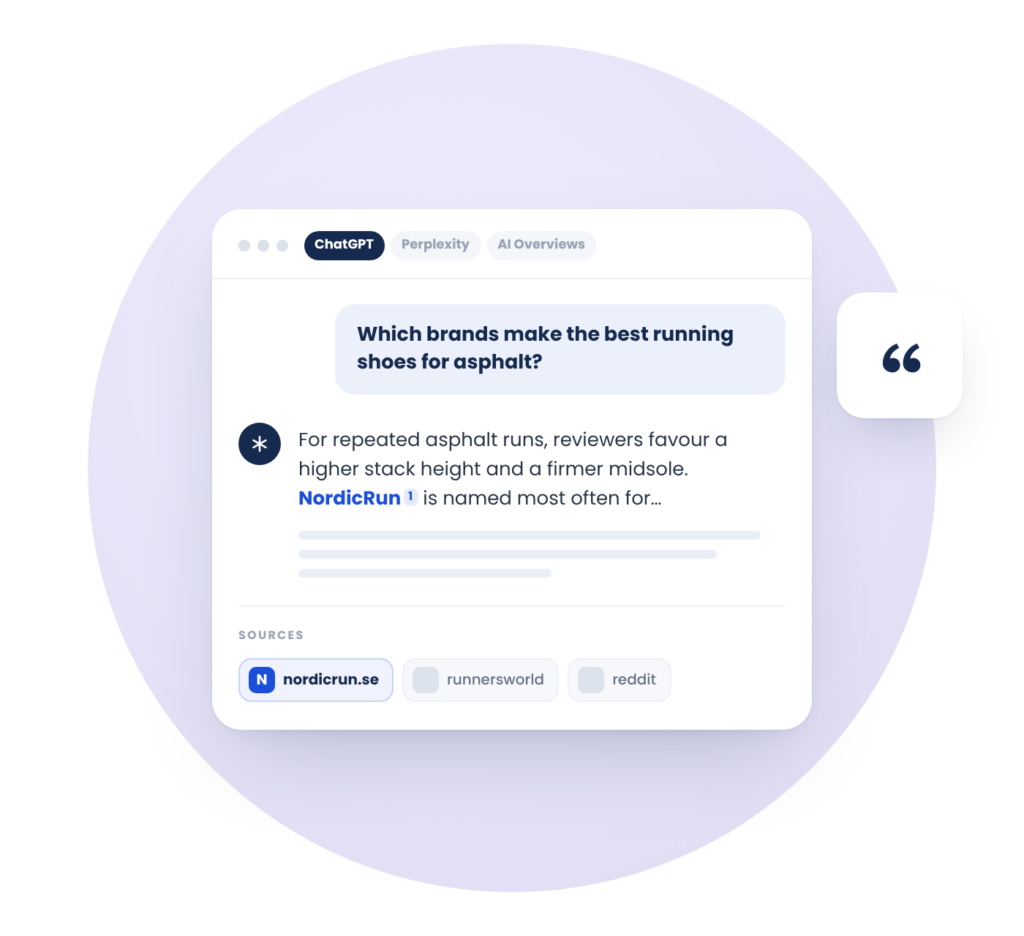
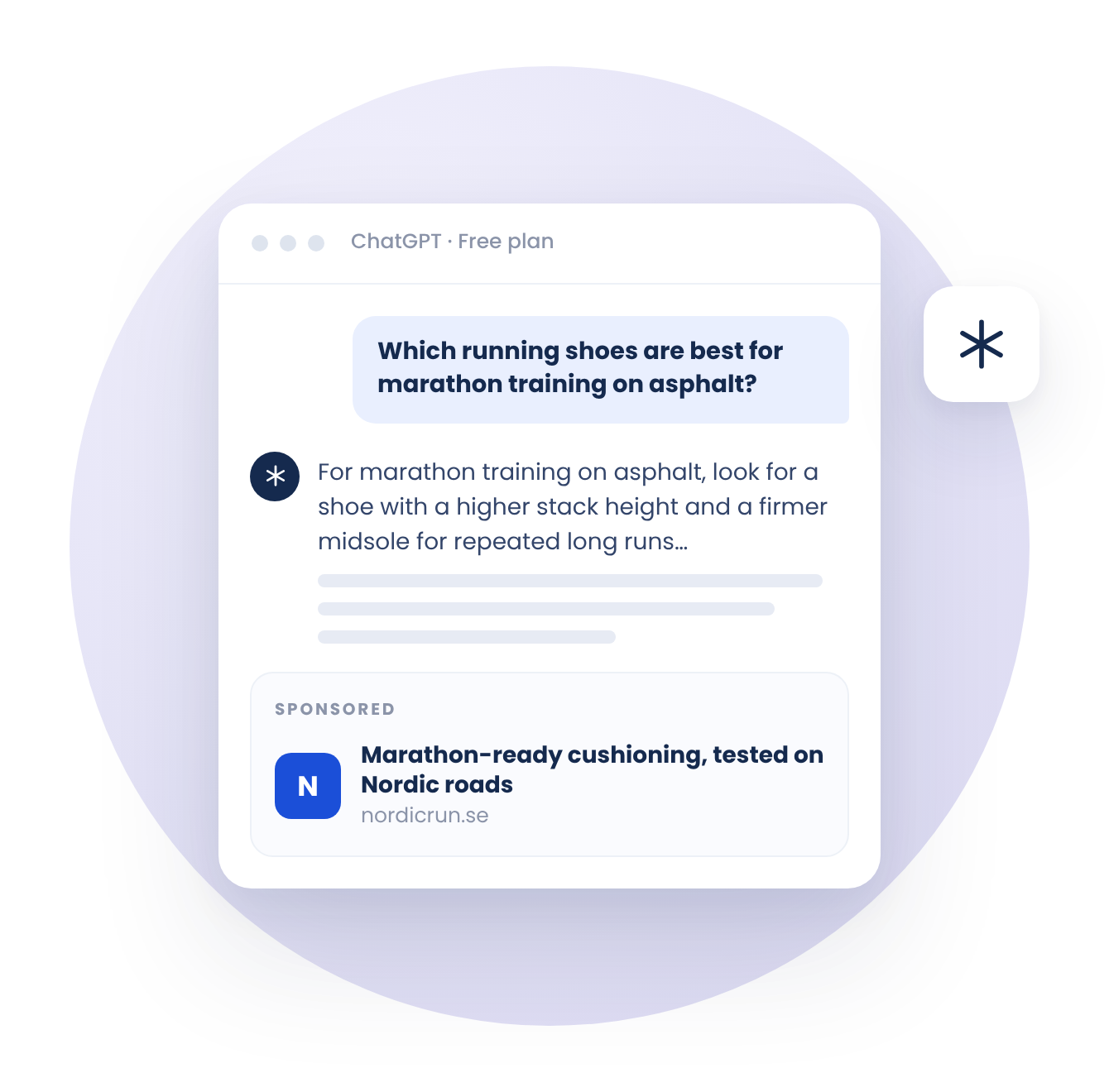
The ChatGPT answer and the sponsored card beneath it are two different purchases on the same screen. One is an auction. The other is earned.
Most GEO advice is written for the American market, where both surfaces arrived together. In Europe they didn’t, and the gap changes what the work is worth.
ChatGPT Ads went live across 31 European countries in August 2026, Sweden, Norway and Denmark among them. You can buy placement inside ChatGPT today.
Google’s ads in AI Overviews are English-only and run in twelve countries, none of them in the EU. You cannot buy placement inside Google’s AI answers in Europe at all. And in the markets where you can, Google states that it offers no segmented reporting for those placements.
So the European position is: a live paid surface inside ChatGPT, no paid surface inside Google’s AI answers, and incomplete reporting on both. That is the inverse of the US picture. It means the organic side of Google’s AI answers carries more weight here than any American playbook assumes, and that the ChatGPT surface is a genuine choice between buying placement and earning citation.
There is a second European difference, and commercially it matters more. Personalised audience targeting isn’t available in the EEA, which makes ChatGPT Ads a contextual channel rather than an audience one. For some categories that makes organic citation the better investment. For others the reverse is true. It’s a measurement question, not a matter of opinion.
We work both halves, so we can answer the question an agency with only one cannot: which of them is cheaper for you, in your category, right now.
On our own site we tested a content strategy built for both Google and language models. On individual articles, LLM-referred sessions reached up to 86.7 % of pageviews.
That is one case, on individual articles, on our own domain. We publish it because the method is written down and can be checked, not as an outcome we promise you. Read the case study →