


Table of Contents
TL;DR: The Dual-Platform Arbitrage
- The CPC Gap: Google Ads maintains massive volume, but rising costs make it inefficient for strict B2B targeting. In our analysis, Microsoft (Bing) Ads delivered a 20% lower Cost-Per-Acquisition (CPA).
- The Demographic Shift: Bing now controls roughly 30% of US desktop searches, capturing older, higher-income decision-makers using corporate networks.
- The Strategic Fix: Do not abandon Google. Instead, hedge against rising CPCs by allocating 10–25% of your total paid search budget to Bing to capture cheaper, high-intent conversions.
For years, we treated Microsoft Ads (formerly Bing) as an afterthought. It was the platform you set up only if you had leftover budget.
Then we analyzed the acquisition costs across our B2B clients in early 2026. We noticed a severe inflation in Google’s mobile traffic costs. To counter this, we tested a hybrid strategy: pulling a fraction of the budget from Google and allocating it to Microsoft’s network.
The resulting data completely changed how we structure paid search campaigns.
The 2026 Benchmark: Platform Efficiency Data
When you look at raw volume, Google holds a dominant 82% to 90%+ market share depending on the sector. But when you look at strict financial efficiency, the narrative shifts.
Here is the aggregated performance data comparing the two networks:
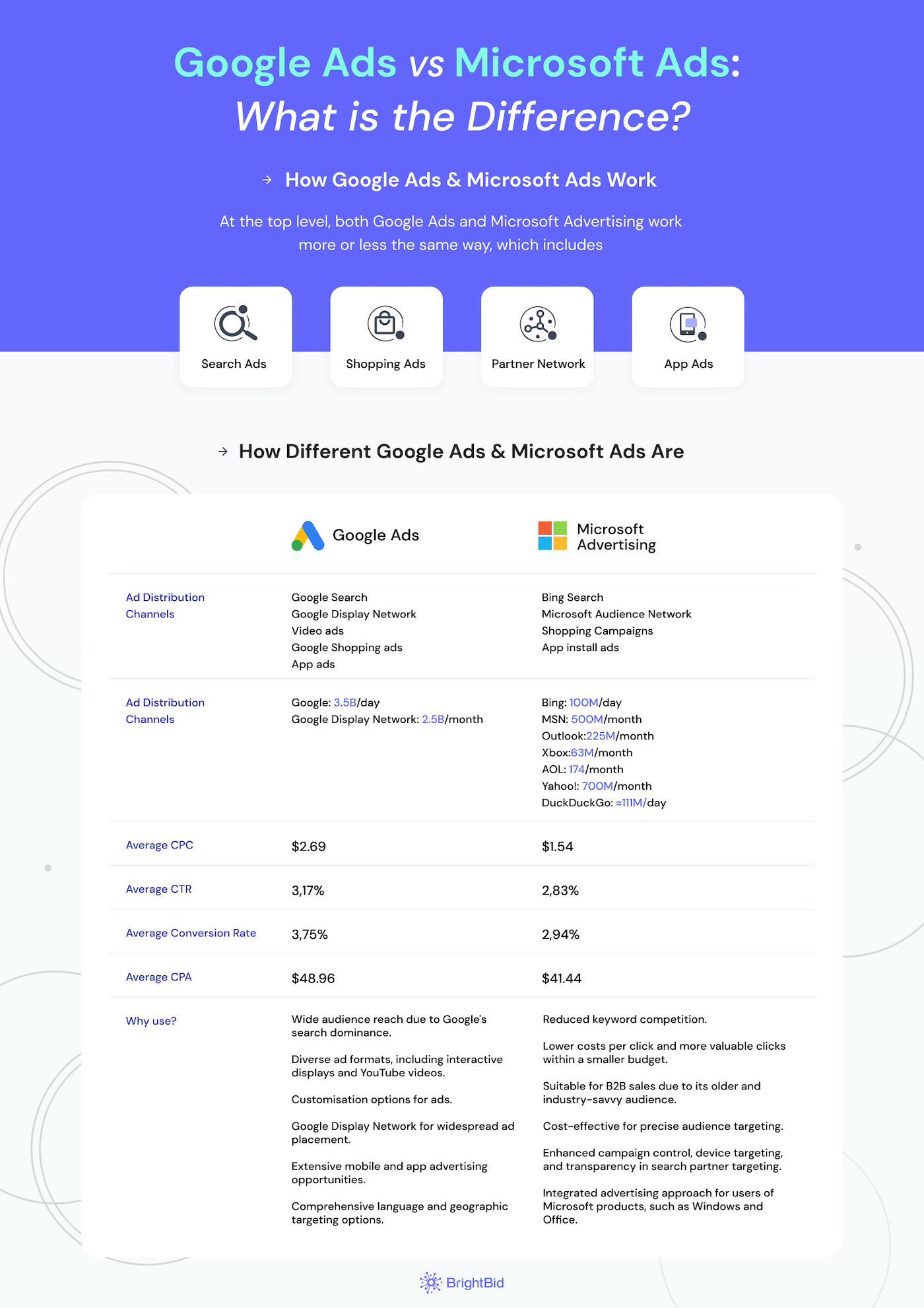
| Metric | Google Ads | Microsoft (Bing) Ads | The Delta |
| Cost-Per-Click (CPC) | $2.85 | $1.45 | Bing is 49% cheaper |
| Cost-Per-Acquisition (CPA) | $48.00 | $38.50 | Bing is 20% cheaper |
| Click-Through Rate (CTR) | 3.25% | 3.10% | Google leads |
| Conversion Rate | 4.10% | 3.50% | Google leads |
While Google converts at a slightly higher absolute percentage, the fundamental acquisition cost on Bing is drastically lower. If you rely solely on Google, you are entirely missing the 63 million searches happening exclusively on the Microsoft Network.
The Logic Chain: Why the Arbitrage Exists
Why are Bing Ads sometimes 2x to 5x cheaper for identical keywords? The answer lies in demographic architecture and targeting features.
First, we must look at the device split. Google completely dominates mobile search and immersive ad formats (like Google Shopping product ads). Conversely, Bing’s strength is desktop search. Because Bing is the default search engine on Windows PCs, its user base skews older, higher-income, and overwhelmingly desktop-based. Many of these users are professionals executing searches from their work computers.
Second, Microsoft integrated deep LinkedIn profile targeting directly into Bing Ads.
Therefore, if you are a B2B company, Google forces you to rely on broad algorithmic signals (like those used in Performance Max campaigns) to find a decision-maker. Bing allows you to explicitly target that decision-maker based on their industry, job function, or company via LinkedIn data, while simultaneously paying a $1.45 CPC instead of $2.85.
Google captures mass visibility. Microsoft captures corporate precision.
The Proof: B2B Efficiency in Action (Amity Case Study)
In highly competitive B2B software sectors, finding cost-efficient growth requires looking beyond standard broad-targeting campaigns. When our client Amity needed to scale globally, relying solely on the most expensive search auctions was not sustainable.
By utilizing AI to optimize their paid search ecosystem, identifying cheaper, high-intent conversion paths across 69 markets, the efficiency gains validated our core thesis on B2B search economics. By aggressively hunting for lower CPCs and better intent targeting, the results were definitive:
- Cost Per Sales Accepted Lead (CPL): -47%
- Sales Accepted Leads (SALs): +39%
- Cost-Per-Click (CPC): -34%
This data proves that diversifying your search strategy and aggressively hunting for lower CPCs, whether through alternative networks like Bing or AI-driven campaign restructuring, is the most reliable way to profitably scale B2B lead generation.
Execution: The 10-25% Rule
You do not need to choose one platform over the other. The most resilient AI digital marketing strategy in 2026 is diversification. Relying exclusively on a single platform leaves you highly vulnerable to sudden algorithm shifts or CPC spikes.
The actionable workflow:
If you have the budget, establish your baseline on Google Ads. Then, carve out exactly 10% to 25% of that budget and deploy it on Bing. You can import your Google campaigns directly into the Microsoft UI to save time.
Use Bing’s Auction Insights to monitor competitor keyword performance. You will frequently find high-value, low-competition keyword gaps that your competitors missed because they only look at Google.
FAQ: Google and Bing (Microsoft) Ads
Which is better in 2026: Google Ads or Bing Ads?
Neither operates perfectly in isolation. Google Ads offers unparalleled volume and advanced automation. Bing Ads offers a 20% lower Cost-Per-Acquisition and unmatched B2B targeting precision. The highest ROI comes from a dual-platform approach.
Is Bing Ads actually cheaper than Google Ads?
Yes. Based on our 2026 data, Bing Ads average a $1.45 CPC compared to Google’s $2.85 CPC. The lower advertiser competition on Microsoft’s network directly results in cheaper auctions.
Should I use both platforms simultaneously?
Yes. A hybrid strategy acts as a financial hedge. It allows you to maintain mass market reach on Google while subsidizing your blended CPA by capturing cheaper, high-intent desktop traffic on Bing.
How do I target B2B buyers specifically?
Bing allows you to overlay LinkedIn profile data, including company, job function, and industry, directly onto your search campaigns. This is a critical advantage over Google for isolating enterprise decision-makers.
How does BrightBid optimize Google and Bing Ads together?
BrightBid utilizes an AI-powered platform to automate and optimize campaigns across both Google Ads and Microsoft (Bing) Ads simultaneously. Instead of manually shifting budgets, our engine continuously analyzes real-time performance data to reallocate your spend toward the most cost-efficient conversion paths, ensuring maximum ROI across the entire search landscape.


 ” />
” />


 ” />
” />
 ” />
” />
 ” />
” />