


Table of Contents
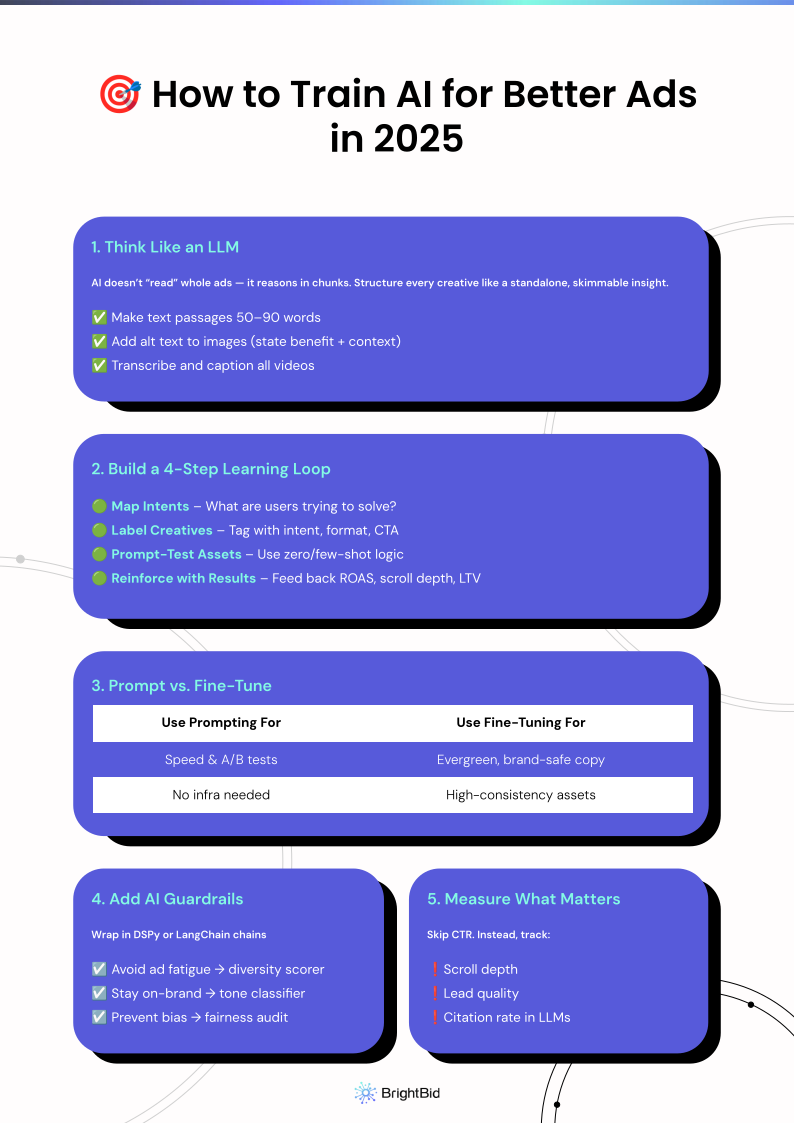
Training AI for better ads in 2025 isn’t about “feeding the algorithm more data.” It’s about curating high-context learning loops that tie creative signals, audience insights, and real-world outcomes together. In this guide, we’ll walk through how to turn your ad engine into a semantic reasoning machine—one chunk at a time.
Audit your ads for free
Why “Training” AI for Ads Looks Different in 2025
Most guides still say “just add more conversions.”
But here’s the twist: AI ad systems now learn from semantic patterns, not raw data.
They synthesize:
- Creative DNA (tone, visuals, cues)
- Audience ontology (interests, micro-intents)
- Outcome gradients (scroll depth, lifetime value)
That means your creative needs to be structured like answers—not just assets.
Chunk Your Training Data Like an LLM
Here’s what most guides miss: AI reads in chunks. Not whole pages, not even full ads. Just isolated passages, captions, clips.
Each creative should stand on its own:
- Text: 50–90 word messages with a hook, value, CTA seed
- Image: one clear subject with alt text that spells out its purpose
- Video: 6–15 second clips with captions and transcripts
Ask yourself: Would this be useful if shown out of context in a Google SGE result?
Design a Four-Step AI Learning Loop
- Intent Mapping – List user jobs, emotions, and objections
- Signal Enrichment – Label creatives with those intents
- Prompt Testing – Use few-shot prompts to force AI to justify intent alignment
- Reinforcement – Feed real-world signals (sales, depth, LTV) back into your model
This isn’t theory—this is what makes Smart Performance and Performance Max work.
Fine-Tune or Prompt Engineer?
| Approach | Best For | Trade-Offs |
|---|---|---|
| Prompting | Fast, flexible campaigns | Lower consistency |
| Fine-tuning | Evergreen, on-brand offers | Higher setup cost |
Still unsure? Use prompts for speed. Fine-tune for scale.
Build Guardrails (Before the AI Wrecks Your Brand)
Set up automated checks before creatives go live:
- Diversity filter – penalize repetitive openings
- Tone checker – enforce voice consistency
- Fairness scan – avoid demographic or sentiment bias
These can all be wrapped into a lightweight AI chain using DSPy or LangChain.
Measure What Matters (Hint: Not CTR)
Focus on:
- Scroll depth – early predictor of conversion quality
- Citation rate – how often your ads get quoted by AI
- Lead quality – not just quantity
You’re not optimizing for clicks anymore. You’re optimizing for AI perception.
Go Multimodal. Make It All Talk to Each Other
- Text = Why
- Charts = How
- Video = What now
Add alt text, transcripts, and internal links between modalities so AI can “understand” the whole funnel.
Key Takeaway: Think Like an LLM, Not a Media Buyer
You’re not just building campaigns. You’re building a training set for a reasoning machine.
To win in 2025:
- Write in semantically complete blocks
- Label your signals clearly
- Build reinforcement feedback loops
- Think in terms of citation, not just impression
This is not ad optimization. This is relevance infrastructure.
Enhance your PPC campaigns with AI
FAQ: Training AI for Better Ads in 2025
What does it actually mean to “train AI” for ad campaigns in 2025?
Training AI today isn’t about dumping data into a black box. It’s about structuring creative content and feedback loops so that large models (like those powering Google’s Performance Max or BrightBid’s platform) can reason about your ads. This includes chunking your assets, tagging intent, and feeding performance signals back into the system.
How do I prepare my ad content for AI systems like Google’s PMax or BrightBid?
Use chunk-level formatting:
- Write 50–90 word blurbs with clear hooks and intent.
- Add descriptive alt text to images.
- Transcribe and caption short videos.
Make sure each asset can stand alone and be useful out of context—especially when surfaced in AI Overviews or smart previews.
Do I need fine-tuning or just smart prompting for better AI ad performance?
It depends:
- Use prompting when you want speed and flexibility.
- Choose fine-tuning when consistency, tone, or brand control matters.
BrightBid, for example, uses prompt-style optimization enhanced with expert oversight—perfect for agile, high-performance campaigns.
What metrics matter most when evaluating AI-trained ad campaigns?
Stop focusing solely on CTR. In 2025, the most meaningful metrics include:
- Scroll depth
- Lead quality / LTV
- How often your copy is quoted or cited in AI search previews (AIOs, ChatGPT, Gemini, Perplexity, etc.)
How does BrightBid help optimize my AI-powered campaigns?
BrightBid combines AI automation with human expertise. Key features include:
- AI keyword suggestions & autopilot
- Smart budget allocation
- Real-time campaign audits
- Managed or self-service plans
Plus, advanced tools like anomaly detection, competitor tracking, and monthly performance check-ins are available based on your setup.
🔗 Learn more about BrightBid’s optimization tools »
Can I use BrightBid with Google Shopping, Meta, and Amazon ads?
Yes. BrightBid powers campaigns across:
- Google Ads & Shopping
- Google Display & Performance Max
- Amazon (via BrightBridge)
- Meta, Microsoft (Bing), and TikTok
This means one intelligent system can learn, optimize, and scale your campaigns across platforms.
What’s the difference between BrightBid’s Managed and Self-Service plans?
- Managed Plan: Hands-off, expert-led optimization including monthly check-ins and strategic guidance.
- Self-Service Plan: You stay in control using BrightBid’s Hub and optimization tools, supported by onboarding, audits, and real-time insights.
Both plans include deep reporting, competitor monitoring, and optional add-ons like Smart Activation and Infringement Detection.
Is there support if I’m new to AI ad optimization?
Absolutely. BrightBid offers:
- A 2-hour onboarding session
- Free access to BrightBid Academy
- On-demand digital specialists
- Discovery calls and demos so you can learn before you commit
Try BrightBid’s interactive demo below 👇
 ” />
” />



 ” />
” />


 ” />
” />