ChatGPT Ads shows a clearly labeled ad block underneath ChatGPT’s answer – never inside the AI-generated text itself.
Targeting
Targeting is contextual: OpenAI matches ads to the topic of the live conversation plus advertiser-supplied “topic hints,” not keywords or demographics.
Who sees them
Only ChatGPT’s Free and $8/month “Go” tiers ever see ads. Plus, Pro, Business, Enterprise and Education stay completely ad-free.
Access
Self-serve Ads Manager is now live in Sweden and Norway as of September 1, 2026 – independent agencies and in-house teams can set up and run campaigns directly, no longer only through OpenAI or a named partner.
Pricing
Typical pricing so far: roughly $25 CPM or $3–5 CPC, with a conversion-based (oCPC) option now in beta.
Measurement
OpenAI now also provides an official Google Tag Manager template for the conversion pixel – Brightbid has tested it and confirmed it works correctly.
What Is ChatGPT Ads, Exactly?
ChatGPT Ads is a genuinely new advertising surface: not search, not social, but a new channel that reaches people while they’re actively asking, comparing and deciding inside a conversation.
The ad unit
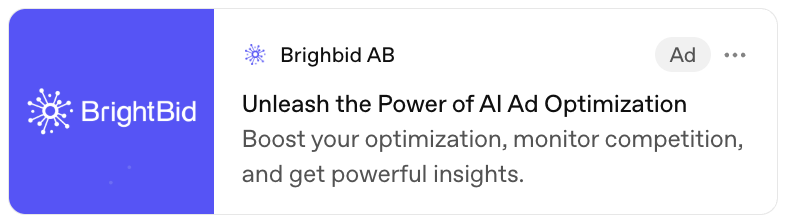
An ad appears as a distinct card: advertiser logo, headline, short description, image and link:
Separation
It’s visually separated from ChatGPT’s own response – OpenAI is explicit that ads never appear inside the AI-generated answer, and never influence what ChatGPT says.
Exclusions
Ads are excluded from sensitive topics (health, mental health, politics) and from any conversation flagged as involving a minor.
Still in testing
A multi-product carousel format – showing several products from a feed at once – is currently in testing, aimed mainly at retail and e-commerce advertisers.
The Timeline So Far
ChatGPT Ads has moved fast, even by AI-industry standards:
Feb 2026
Invite-only US beta; $200K min. spend, ~$60 CPM.
Apr 2026
US minimum spend cut to $50K.
May 5, 2026
Self-serve launches in the US; minimum spend removed.
Jun–Jul 2026
Expands to Canada, Australia, NZ, UK, Mexico, Brazil, Japan, South Korea.
Aug 6, 2026
ChatGPT passes 1B weekly active users globally.
Aug 24, 2026
Managed-mode launch in 31 European countries, incl. Sweden & Norway.
Sept 1, 2026
Self-serve opens across Europe, including Sweden and Norway.Live now
ChatGPT Ads Self-Serve Is Now Live in Sweden and Norway
As of September 1, 2026, self-serve Ads Manager is live across Europe – including Sweden and Norway. Independent agencies and in-house teams can now set up and run ChatGPT Ads campaigns directly, without routing through OpenAI’s own Ads Solutions team or one of the named global partners.
That’s a change from the managed-only access that applied right after the August 24, 2026 European launch, when advertisers in Sweden and Norway could only reach ChatGPT Ads through:
Route 1 — until Sept 1
OpenAI’s own Ads Solutions team
Route 2 — until Sept 1
A short list of named global partners
OpenAI had said self-serve would follow “later this summer” without a confirmed date – and it landed almost exactly on that promise, about a week after Europe’s managed-mode launch. The extra week versus the US rollout tracks with what we expected: Europe requires explicit opt-in consent for ad personalization under GDPR, a slower build than the opt-out model OpenAI used in the US.
What this means practically
This is no longer a “prepare and wait” situation. You – or your agency – can create an account, install the conversion pixel, set up topic hints and launch a campaign today. Reporting and targeting maturity are still well behind Google and Meta at this early stage, so treat initial budget as a test rather than a scaled media plan.
An Official Google Tag Manager Template Has Shipped
OpenAI now provides its own GTM template for the ChatGPT Ads pixel, so setup no longer requires a manual custom-HTML build.
Tested by Brightbid
Brightbid has tested it internally and confirmed it works correctly out of the box. You can install the pixel either through the GTM template or manually, and you can reuse your existing triggers connected to your other platforms – the same as with any other ad platform setup. The one caveat: you need to map the conversion event ID from ChatGPT Ads to the corresponding event ID in GTM to connect the two.
Brightbid’s Predicted Roadmap: What Happens Next
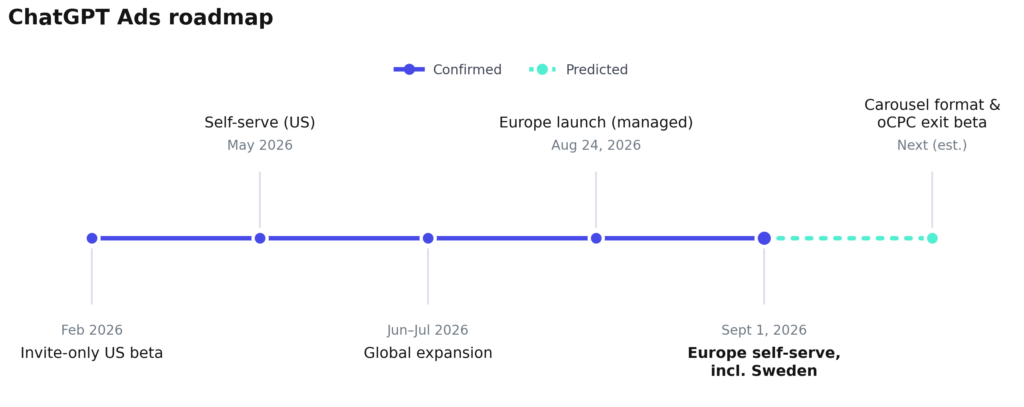
Everything below “Today” in the chart above is our own estimate, not an OpenAI commitment – treat it as a planning assumption, not a date to promise clients.
Brightbid estimate
The multi-product carousel format graduates from testing. No date has been given by OpenAI; this is our own extrapolation based on how long comparable ad formats usually stay in limited testing. Retail and e-commerce advertisers should treat this as “coming,” not “available.”
Brightbid estimate
oCPC (conversion-based bidding) exits beta. Currently in beta for product-feed campaigns; we’d expect broader availability to follow the carousel format out of testing, though again this is an estimate, not a confirmed date.
Brightbid estimate
The named-partner list keeps growing before self-serve does. Expect OpenAI to add more agency and ad-tech partners in the “managed mode” tier for markets that haven’t opened self-serve yet – worth rechecking the ads.openai.com partner list periodically.
Who Sees ChatGPT Ads?
Only people on ChatGPT’s Free tier and the $8/month “Go” tier ever see ads. Every paid tier – Plus, Pro, Business, Enterprise and Education – stays completely ad-free.
Read the numbers carefully
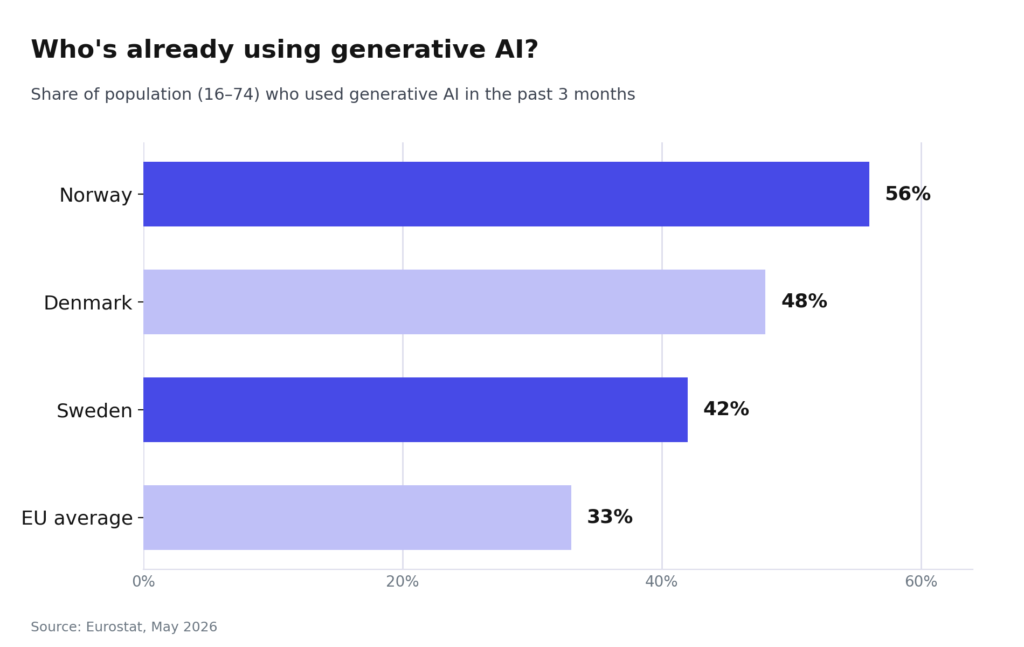
None of the market data below is ChatGPT ad-inventory data (that doesn’t exist yet for Sweden or Norway); it describes the addressable audience you’d eventually be reaching, not a media-planning benchmark – and it doesn’t break out how much of that audience sits on an ad-eligible tier.
Sweden, in more detail
34%
of the population has used ChatGPT specifically – it dominates the local AI landscape, with Microsoft Copilot at 10% and Google Gemini at 2%.
Novus / Computer Sweden, January 2025
41%
of Swedish internet users aged 8+ have used an AI tool in the past 12 months, rising to 57% among 8–19-year-olds.
Internetstiftelsen, “Svenskarna och internet” 2025
76% → 12%
Usage is heavily generational: 76% among 15–25-year-olds, dropping to 12% among people born in the 1950s.
Internetstiftelsen, 2025
50% vs 20%
Among employed white-collar Swedes, usage is roughly 50% for ChatGPT versus about 20% for Copilot, skewing higher in economics, education, IT and engineering roles.
White-collar workforce
~1 in 5
Swedes now use AI instead of a traditional Google search.
Search-behaviour shift
Norway, in more detail
54%
of Norwegians aged 16–79 used generative AI in the past 3 months – up 18 percentage points from 36% in 2024.
Statistics Norway / SSB, September 2025
30%
of Norwegian enterprises with 10+ employees now use AI technology, double the 15% recorded in 2024. Large enterprises (99+ employees) sit at 58% adoption. The main barriers non-adopters cite are lack of internal AI competence (77%) and data-protection or legal uncertainty (40%).
Statistics Norway / SSB, September 2025
Generative AI use in Norway, by age group
Every age group under 75 grew year-over-year. Source: Statistics Norway / SSB, September 2025.
16–24
80%
25–34
70%
35–44
~70%
45–54
56%
How ChatGPT Ads Actually Works
Targeting is contextual, not keyword- or audience-based. OpenAI runs a relevance-weighted auction using the topic of the live conversation, the user’s chat context, and advertiser-supplied “topic hints” – broad category signals rather than exact-match keywords. Porting a Google Search keyword structure over directly doesn’t work; the closer mental model is semantic or contextual targeting.
Account structure is different from Google’s MCC model. There’s no agency-owned master account yet. The client’s brand signs up and gets approved first; an agency is added afterward as a user on that account – a workflow detail worth building into onboarding from day one.
Campaign structure runs campaign → ad group (budget, bid, pacing) → individual ads (headline, description, image, link), with an optional product feed for the carousel format currently in testing.
Bidding options at the self-serve launch (US: May 2026, Europe: September 2026)
CPM
~$25
Down from an initial $60 at beta launch.
CPC
$3–5
OpenAI’s own starting recommendation for a max CPC.
oCPC Beta
Conversion-based
Now in beta for product-feed campaigns. We expect these to develop further with more emphasis on ROAS & CPA bidding – this is what is available at launch.
Measurement runs through OpenAI’s own pixel, with automatic advanced matching on by default (hashing an on-page email address client-side, the same concept as Meta’s Advanced Matching or Google’s Enhanced Conversions), plus a server-side Conversions API for clients who want that instead of, or alongside, the browser pixel.
Set up via the official GTM template (see above) or manually – both routes work, and Brightbid has verified the GTM path directly. A free third-party community template, Stape’s “OpenAI Ads Pixel,” still works as an alternative if you’d rather not use OpenAI’s own template.
Reporting in Ads Manager covers impressions, clicks, CTR, spend and conversions, all aggregated; advertisers never see individual chats or user-level data.
What you need: platform / client side
A payment method installed
Ad creative: headline, description, image or logo, and landing page URL.
“Topic hints” (broad category signals) instead of keywords. For contextual signals.
A conversion pixel installed on the client’s website.
eCommerce: A product feed, if using the multi-product carousel format (currently in testing).
What you need: from clients generally
A pilot mindset – this is a beta product with materially less mature reporting and targeting than Google or Meta; budgets should be framed as tests, not scaled media plans.
Landing pages and creative adapted for a no-keyword, context-driven format.
ChatGPT Ads vs. Google Ads: A Quick Translation
If your team already runs Google Ads, most of the underlying mechanics – auction-based bidding, budgets and pacing, conversion tracking, UTM-style attribution – will feel familiar. The real learning curve is the targeting model, not the whole discipline.
Targeting & optimization best practices (emerging playbook)
Best practices are still forming on this platform, but a few principles are already backed by OpenAI’s own documentation:
Segment ad groups by conversational intent, not broad topics – for example, split “running shoes” into “beginner running shoes,” “marathon training,” and “trail running,” while keeping campaigns broad on budget, objective and geography. This matches OpenAI’s own guidance to run multiple ad groups per campaign to test themes and messaging.
Make creative and landing pages answer the conversation. OpenAI’s matching system explicitly weighs landing page content as a relevance signal, so each ad group’s landing page should match its specific intent rather than pointing at a generic homepage.
Match bidding to intent: CPM for reach, CPC for traffic, oCPC for downstream actions. OpenAI’s own starting recommendation is a $3–5 max CPC, though the right bid depends on category economics.
Feed conversion data back early. Ads Manager reports impressions, clicks, spend, CTR, CPC/CPM and conversions – the platform is clearly moving toward outcome optimization, not just impression delivery.
Don’t port a Google Search structure over 1:1. Context hints aren’t keywords – OpenAI is explicit that they guide matching but don’t guarantee delivery against specific conversations.
Is ChatGPT Ads Right for Your Brand?
Good early candidates
E-commerce and DTC brands with clean, structured product feeds – well positioned for the carousel format once it leaves testing.
Brands open to funding genuine test budgets for consideration and awareness, not brands expecting immediate scaled performance.
Brands already comfortable with an agency running experimental or beta channels.
Better to wait
Anyone expecting Google- or Meta-level targeting precision and mature reporting on day one.
Highly regulated or sensitive-topic categories – health, finance, politics.
Anyone unwilling to treat initial spend as a learning investment rather than a guaranteed-return channel.
Risks and Limitations to Set Expectations On
!
No demographic or behavioral targeting yet – contextual “hints” only.
!
Measurement and reporting are materially less mature than Google or Meta.
!
Reach in Sweden and Norway will be small at first – self-serve access only opened on September 1, 2026, so inventory and campaign volume are still ramping up.
!
This is openly a beta product; OpenAI is iterating quickly.
!
Self-serve is brand new in Europe – expect rough edges in reporting and support responsiveness as OpenAI scales up its EU operations.
Getting Started: Your Launch Checklist
Self-serve is live – here’s the order that gets you from zero to a running campaign fastest:
Set up measurement first.
Install OpenAI’s conversion pixel (via the official GTM template or manually) and get advanced matching working before you spend a single krona.
Build topic hints, not keywords.
Translate your product catalogue and search-query data into intent clusters ChatGPT can actually match against.
Adapt creative for the format.
A 50-character headline and a description that reads naturally underneath a conversational answer is a different writing exercise than a Google RSA.
Align landing pages to intent.
OpenAI’s matching system weighs landing page content as a relevance signal – a generic homepage link works against you.
Fund it as a pilot.
Treat initial budget as a test, not a scaled media plan; reporting and targeting maturity are still well behind Google and Meta.
How to Stay Up to Date
ChatGPT Ads is changing faster than most ad platforms – pricing alone has shifted three times in 2026. If you’re tracking this, keep an eye on:
Will it look like ChatGPT is endorsing our product?
No. Ads are clearly labeled and visually separated from ChatGPT’s own answer, and OpenAI states that ads never influence the answers ChatGPT generates.
Is ChatGPT Ads safe for our brand?
OpenAI excludes sensitive topics – health, mental health and politics – and any conversation flagged as involving a minor from ad delivery, and requires clear ad labeling throughout.
How much should we budget to test ChatGPT Ads?
Frame it as a discovery budget. There’s no minimum spend in self-serve markets, so start small and treat early results as directional rather than conclusive.
Can Brightbid run ChatGPT Ads for us in Sweden or Norway right now?
Yes. Self-serve access opened across Europe, including Sweden and Norway, on September 1, 2026, so Brightbid can now set up and actively manage ChatGPT Ads campaigns for you directly – no longer only through OpenAI’s managed-mode partners. We’ve already tested the official conversion-tracking setup, including the new GTM template, and are ready to launch.
Does OpenAI see our customers’ data?
No. OpenAI states advertisers receive only aggregated performance metrics – impressions, clicks, conversions – never individual chat content or personal data.
How is ChatGPT Ads different from Google Ads targeting?
Google Ads matches on keywords and audience signals; ChatGPT Ads matches on the contextual topic of a live conversation plus advertiser-supplied topic hints. There’s no exact-match equivalent yet.
Get Ready for ChatGPT Ads with Brightbid
ChatGPT Ads is moving from beta to mainstream faster than any ad platform in recent memory – and as of September 1, 2026, self-serve access is live in Sweden and Norway. Most agencies haven’t logged into Ads Manager yet, which makes this the moment to launch, not just prepare: get your measurement, creative and targeting strategy live now, while the channel is still uncrowded.
Why You Must Migrate to the Google Merchant API Before August 2026
Google has announced the permanent shutdown of the Content API for Shopping, scheduled for August 18, 2026. Its replacement is the Google Merchant API, a highly modular, programmatic tool designed to automate complex account setups at a scale the old system could not handle.
Here is exactly why moving to the new Merchant API isn’t just a compliance requirement: it is a structural necessity for modern paid search architecture.
We Analyzed How Amity Cut CPL by 47%. Here is the Dual-Platform Strategy
Shifting 10-25% of your search budget to Bing Ads lowers B2B Cost-Per-Acquisition by 20% compared to Google Ads, according to BrightBid data from 2026.
We Heped Watchcom Cut CPC by 55%. Here is the “Negative Keyword” Pattern That Fixed It
Running Google Shopping campaigns can be a great way to reach potential customers. But what happens when your ads show for irrelevant searches? This wastes your budget and frustrates shoppers. That’s where negative keywords come in.



 ” />
” />


 ” />
” />


 ” />
” />