


Understanding your audience is no longer a luxury—it’s essential. Traditional segmentation methods served their purpose, but in today’s hyper-competitive, data-saturated world, they often fall short. That’s where AI comes in. With artificial intelligence, e-commerce businesses can create highly refined segments, target users more precisely, and drive better outcomes. Let’s explore how AI-driven segmentation works, why it matters, and how BrightBid helps you reach the right audience at the right time.
Table of Contents
Benefits of AI-Driven Customer Segmentation
Customer segmentation involves dividing customers into groups based on shared traits, needs, or behaviors. But basic demographic or transactional segmentation barely scratches the surface. AI brings depth, speed, and scalability to segmentation, allowing for insights that were once impossible.
Unlike traditional methods, AI analyzes vast datasets to uncover behavioral patterns, motivations, and real-time shifts. It enables segmentation down to the individual level, making personalization not just possible—but scalable. It is important to train AI right to get the best outcome out of your ads.
Audit your ads for free
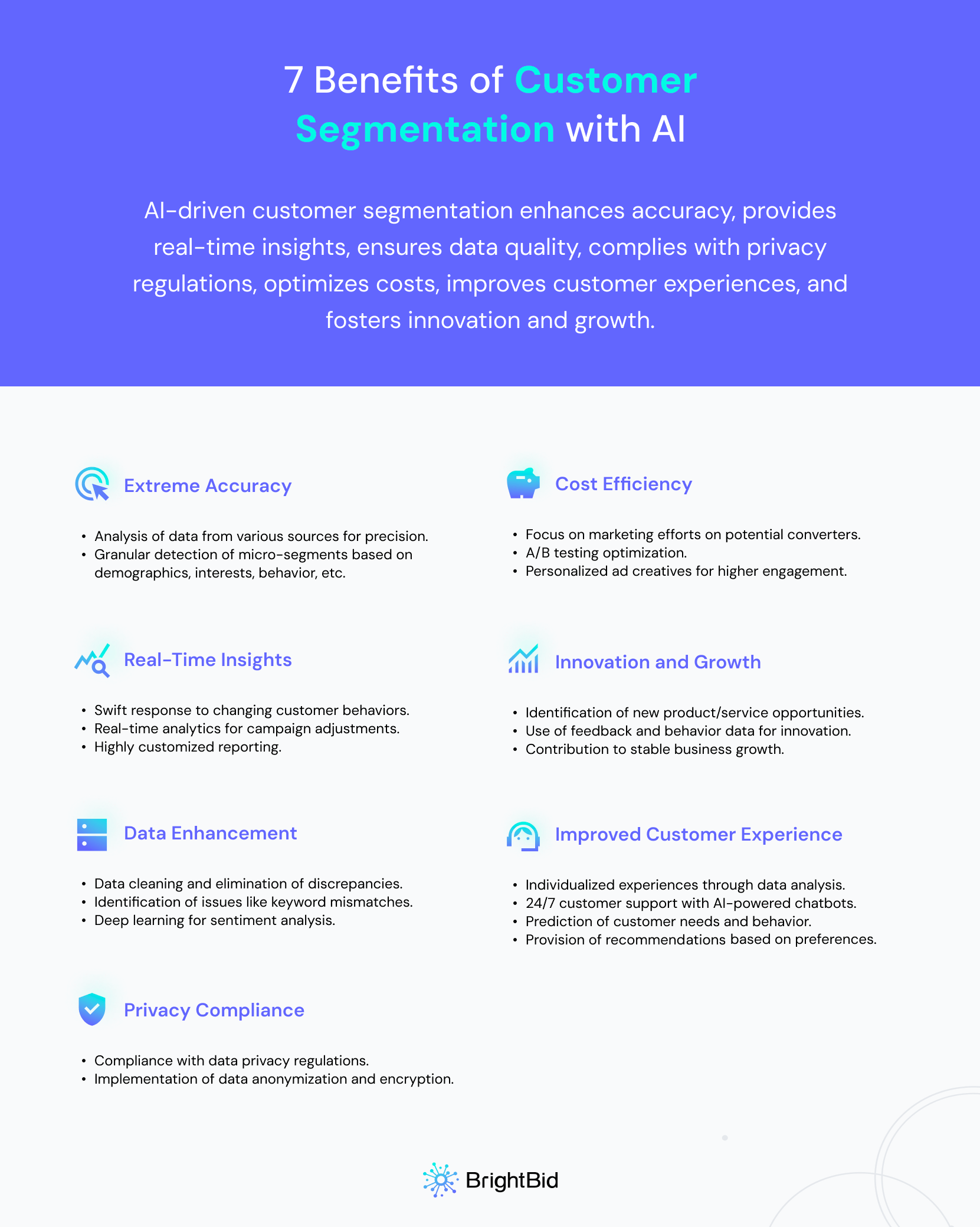
AI Delivers Unmatched Accuracy
AI segments customers based on complex datasets: browsing habits, intent signals, purchase frequency, and even sentiment. By uncovering micro-segments within larger groups, marketers can target niche audiences with extreme precision.
Predictive analytics help forecast future behaviors, while clustering algorithms automatically group users by traits that go beyond the obvious—revealing hidden value across your audience.
Real-Time Insights for Agile Marketing
AI systems deliver continuously updated audience intelligence. Key features:
- Live analytics: Track performance and adjust campaigns in real time
- Custom reporting: Get actionable insights, not just raw data
- Data cleaning: Eliminate duplicates and errors for a true audience picture
- Deep learning: Tap into text, image, and sentiment analysis
- Privacy-first: Stay GDPR-compliant with anonymized data workflows
With BrightBid, AI uncovers inefficiencies in real time—for example, by flagging mismatched keywords targeting the wrong segments.
Smarter Ad Spend, Higher ROI
AI enables more efficient use of advertising budgets:
- Predict which segments are most likely to convert
- Automatically test and optimize creatives across user groups
- Shift budget dynamically from underperforming to high-performing ads
With BrightBid, e-commerce companies benefit from automated A/B testing and campaign adjustments, driving higher returns with less waste.
Better Customer Experience, End to End
AI doesn’t just optimize targeting—it enhances user experience:
- Personalized product recommendations based on browsing behavior
- AI chatbots for round-the-clock support
- Predictive suggestions for upsell/cross-sell opportunities
When your customers feel understood, they stay longer, buy more, and become advocates for your brand.
Innovation & Growth Through Insight
AI segmentation goes beyond campaign efficiency. It opens up entirely new ways to innovate:
- Identify underserved segments for new product ideas
- Align R&D with customer needs uncovered in behavioral data
- Localize offerings based on geography and device behavior
These insights feed into a smarter growth strategy that keeps your business adaptive and future-ready.
7 Tips for Effective AI-Driven Segmentation
- Start with clear goals (e.g. boost ROAS, reduce churn)
- Collect quality data from CRM, web analytics, surveys, etc.
- Use machine learning to reveal hidden patterns
- Include customer feedback to refine segments
- Embed insights into campaigns and ad creatives
- Protect user data with full compliance (GDPR, CCPA)
- Iterate often to optimize over time
BrightBid in Action: Amity Case Study
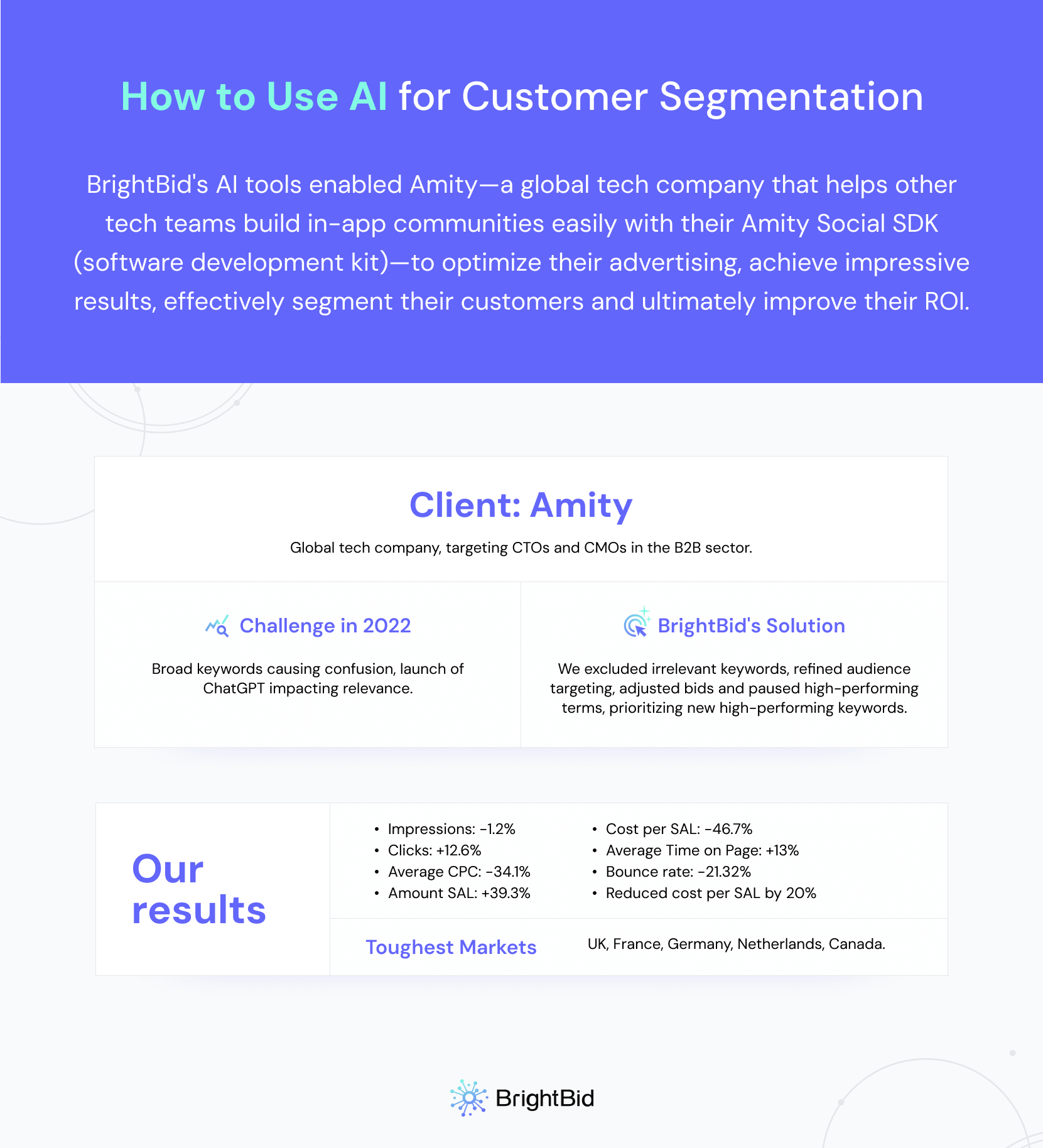
Amity, a global tech company offering in-app community tools, needed help targeting B2B buyers across 69 markets. Their campaigns were disrupted when ChatGPT’s rise confused their “ChatSDK”-related keywords, leading to irrelevant traffic.
How BrightBid helped:
- Blocked wasteful keywords
- Shifted strategy to high-performing, low-volume terms
- Made over 151,000 bid optimizations
- Achieved a 46.7% drop in Cost per SAL and 39.3% increase in Sales Accepted Leads
By refining targeting, adjusting bids, and improving ad copy through AI segmentation, BrightBid helped Amity reach the right audience while cutting ad waste.
Ready to Find Your Best-Fit Customers? Run a free BrightBid ad audit today and discover how AI-powered segmentation can drive results for your business.
Audit your ads for free


 ” />
” />


 ” />
” />
 ” />
” />